

As you explore various avenues for publishing your book, you probably have one major factor in mind: budget. But while some authors are frantically searching online for the most “reasonably priced” package, the savviest authors know that publishing should not be one size fits all. Here’s why:
Different Scope
One author has a twenty-four-page board book targeting readers ages zero to three with very simple illustrations. Another author has a forty-eight-page fully illustrated early reader intended for kids between the ages of six and ten. Do you think they should pay the same amount?
It all comes down to scope. The more work involved in bringing the author’s vision to life, the more it will cost. After all, if an editor has to provide input on a drastically longer story, they should be paid for that additional time and effort. Same if an illustrator has to create twice as many illustrations. And same if a designer has to get extra creative to integrate all that text with the illustrations.
Simply put, if there’s more to do to get the book in publication-ready shape, you can expect to devote a larger budget to the project. It only makes sense, right?
Different Needs
If an author already has professional illustrations that meet industry standards and quality requirements, they shouldn’t have to pay for that service as part of a “package.” That certainly wouldn’t be fair! On the other side of that coin, if an author adds a service, such as audiobook recording, mastering, and distribution, they should have to pay more for that.
It all comes down to what an author truly needs. Pre-set packages sound nice, clean, and simple, but that’s not what true, professional publishing is about. The services should be tailored based on the author’s specific needs and project requirements. That customization is a positive, not a drawback. It lets you know that your project is being handled just the way it should be—not the same way as the last project and the project before that and the project before that . . .
Different Goals
Just as authors have different needs, they usually have different goals. A high-quality publisher will always keep goals front and center throughout the entire production, publishing, and promotional process.
Say an author is a pediatric doctor who is going to need hundreds of copies on hand at any given time to sell directly to patients and parents through their business. Or maybe they have a huge social media following clamoring for them to write a kids’ book, and it’s important to them to have the opportunity for widespread distribution to brick-and-mortar stores as well as online platforms. Perhaps they’ve already published a book with resounding success, and they want to make higher royalties on each sale by printing in bulk on the front end. In cases like these, it might make sense to do offset printing. It’s a larger investment to get high-quality books mass produced, not to mention professionally distributed to retailers, but this is the right call for some authors depending on their goals.
For many first-time authors who don’t have a vast, ready-made audience, print on demand is often a better route to start with, especially if they aren’t going to need tons of books on hand at any given time. The initial investment is smaller because books are printed as they’re ordered, meaning the author doesn’t have to pay for printing upfront. The cost of printing does come out of the net proceeds of each sale, so the royalties are smaller, but there are also no inventory issues to manage. See how different authors with different goals may pay more or less depending on their situation?
Determining Your Budget
So, yes, it can be hard to figure out exactly how much to budget for publishing. Here’s a checklist of items to consider to get a ballpark in your head:
- To determine your editing budget, consider the type of book and word count. Board books, which are for the youngest readers and don’t include much text as they’re typically concept-based, may only require a budget of a few hundred dollars. Picture books usually involve more storytelling but don’t have TOO much text to ensure there’s ample room for the illustrations. You’ll probably need to budget between $500 and $1,000 for that. Chapter books all the way through middle-grade and young adult books mostly comprise text with little to no illustrations. You may budget $.03 to $.05+ per word depending on the complexity of the story and the level of editorial support needed.
- What illustration style are you going for and how many illustrations will you need? For example, hand-drawn artwork and hand-painted watercolor illustrations tend to be more expensive, while digital art may cost a little less because it doesn’t demand quite as much time. Of course, the more illustrations, the higher the cost. After all, the budget is typically established based on the number and type of illustrations required. On a related note, more complex and detailed illustrations cost more. For example, spot illustrations or vignettes are smaller with fewer background details, so they may cost a little less. Two-page spreads spanning both pages when the book is lying open usually cost the most. It goes back to our conversation about scope!
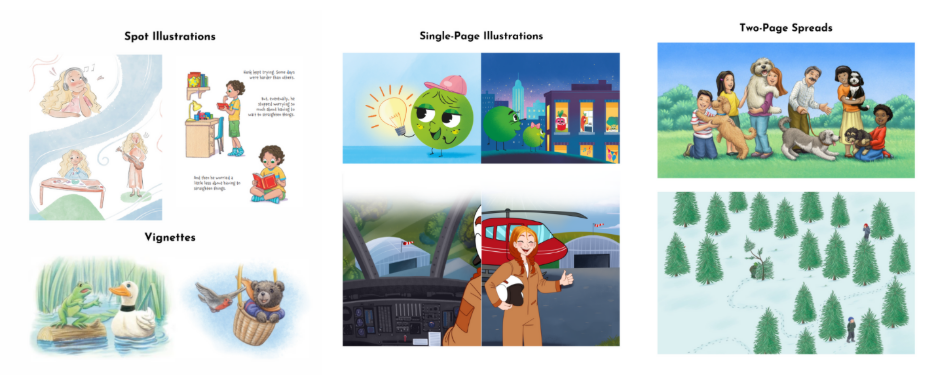
Tip: When an illustrator is particularly well-known or prestigious, they may charge significantly more for their work regardless of the illustration style and number of illustrations. If you’re in love with a widely celebrated illustrator, you may want to use their work as inspiration to find a different artist with a similar style to balance budget with vision.
- Are there any special design elements you’d like in your interior? The more intricate the formatting and interior layout needs, the higher this budget will need to be. For instance, early readers often have a lot of text AND a lot of illustrations. It can be a little more challenging to bring them together artfully without sacrificing anything important. That takes skill, resourcefulness, and ingenuity!
- Do you want to do an offset print run? The more books you print, the less expensive each copy is—and vice versa. So if you print 2,000 copies, you’ll pay more overall, but you’ll pay less per copy than if you printed 1,000. (And you’ll always pay more upfront for a print run compared to doing print on demand, as mentioned above, although you’ll also earn much higher royalties per sale.)
- Are you planning to do hardcover or paperback? It’s more expensive to print hardcover (especially with special design features like embossing, gold foil stamping, ribbon bookmark, etc.).
You may not have gotten super definitive answers here, but you can always check out this blog post outlining more specific cost estimates to narrow down your budget expectations. You can also contact the publishing professionals at Blue Balloon Books—they’re always happy to offer guidance based on your unique goals and needs!
Bottom line, if you want to find the best publishing home for your book, don’t just look at the publishing packages. Dig deep, talk to the professionals, and see what makes the most sense based on your project scope, needs, and goals. A quality publisher will do their best to work with your budget and make the best recommendations to help you publish the children’s book of your dreams.